Air (Gas) Embolism: Why Hyperbaric Oxygen Is the Definitive Treatment
An embolism occurs when something travelling in the bloodstream — here, a bubble of gas called an embolus — lodges in a vessel and blocks blood flow. When that bubble is air or another gas, the condition is called air embolism, gas embolism, or arterial gas embolism (AGE). It is a medical emergency: a bubble that reaches the brain or heart can cut off circulation within seconds.
What causes a gas embolism?
Gas enters the circulation in two main ways. In diving, a rapid or breath-holding ascent can over-expand the lungs, forcing air across the lung membrane into the arterial blood — this is the mechanism behind the most dangerous diving injuries and is closely related to decompression sickness. In medicine, gas can be introduced during surgery, central-line placement, or other procedures. However it enters, the result is the same: bubbles obstruct arteries and starve tissue of oxygen, producing localized hypoxia.
Symptoms of arterial gas embolism
Symptoms appear suddenly, often within minutes of surfacing or a procedure, and depend on where the bubble lodges:
- Sudden loss of consciousness or collapse
- Confusion, dizziness, or stroke-like weakness and numbness
- Vision disturbances or difficulty speaking
- Chest pain, breathlessness, or irregular heartbeat
- Seizures in severe cases
Any neurological symptom appearing right after a dive or an invasive procedure should be treated as a possible gas embolism until proven otherwise.
Why hyperbaric oxygen therapy is the treatment of choice
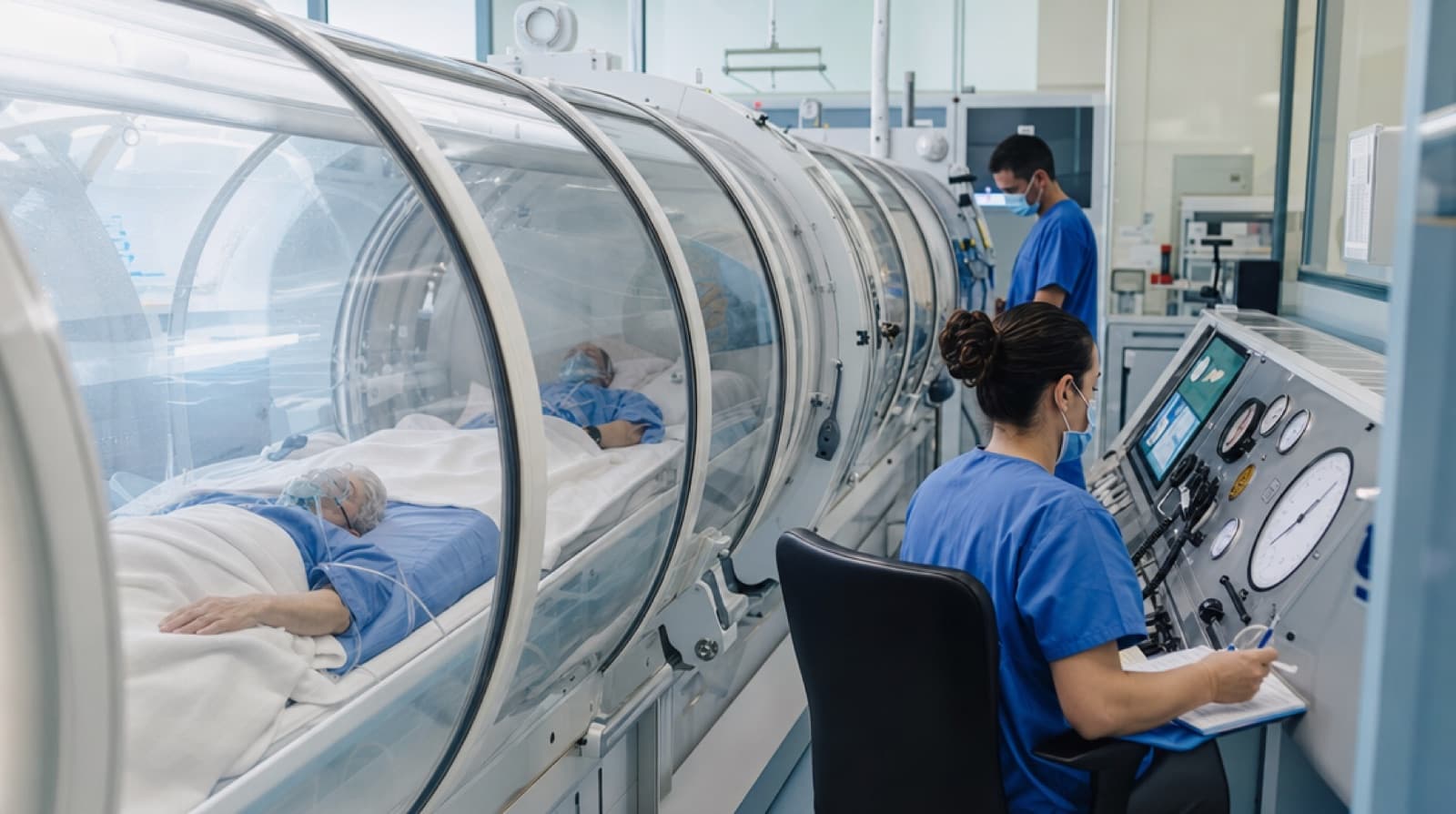
Hyperbaric oxygen therapy (HBOT) is the definitive treatment for gas embolism, and it works through two simultaneous mechanisms rooted in basic physics. First, raising the ambient pressure inside a hyperbaric chamber physically compresses the offending bubbles — following Boyle’s law, higher pressure means smaller bubble volume — so they shrink and can pass through the circulation and dissolve. Second, breathing 100% oxygen at pressure floods the plasma with oxygen, keeping the oxygen-starved tissue downstream of the blockage alive while the bubble resolves, and creating a diffusion gradient that washes the inert gas out of the bubble.
Speed matters enormously. The sooner recompression begins, the better the outcome, which is why divers with suspected AGE are transported to the nearest hyperbaric facility as an emergency.
Prevention
For divers, the core rule is simple: never hold your breath while ascending, and ascend slowly within safe limits. In clinical settings, careful technique during line placement and surgery minimizes the risk. Because the window for effective treatment is short, knowing the symptoms — and getting to a chamber fast — is the single most important factor in recovery.
For detailed medical information, please consult with a qualified healthcare professional.
The related diving injury treated in the same chambers.
Indications, protocols and how treatment works.
The equipment used to recompress and treat embolism.